Pallet Storage Racks help warehouses turn vertical space into usable capacity, but the right system depends on more than aisle width. A distribution center handling uniform cartons may benefit from selective pallet racking, while dense, stable loads may suit drive-in or shuttle systems. Small details matter. Forklift turning radius, pallet condition, ceiling height, sprinkler clearance, and daily picking frequency can change the choice.
This guide introduces leading pallet storage rack types global buyers are likely to compare in 2026, including selective, double-deep, drive-in, push-back, pallet-flow, and mobile racks. It explains how each design affects access, storage density, stock rotation, and operating speed. A rack that looks efficient in a catalog can feel awkward when operators retrieve mixed products during a busy shift. That is worth remembering. Regional pallet dimensions and available service support can also affect long-term performance. Buyers should verify load data, beam levels, floor capacity, installation conditions, and local safety requirements with qualified rack suppliers and engineers. Product labels and published capacities are useful, but they do not replace project-specific checks. This article offers a practical starting point, not a final engineering design. Some warehouses may need a hybrid layout, even if one system seems cheaper at first. By comparing real inventory patterns and handling equipment, buyers can narrow the options and ask clearer questions before requesting quotations.
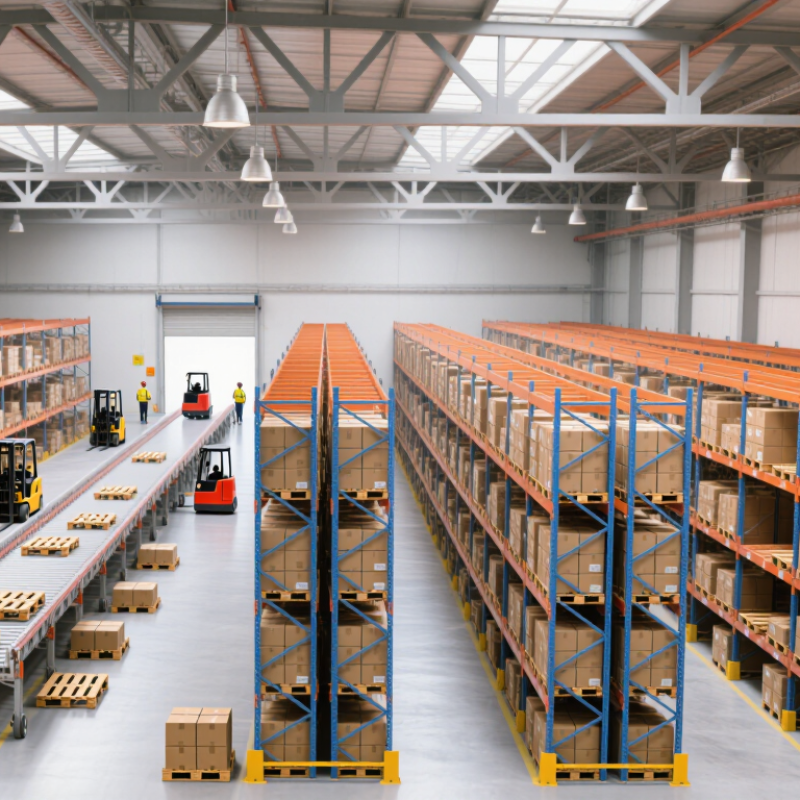
Pallet storage racks are steel structures that hold palletized goods above the floor. Upright frames transfer loads to the floor, while horizontal beams support pallets at set levels. In selective rack systems, forklifts access each pallet from an aisle. Drive-in designs trade some access for denser storage; pallet-flow systems use rollers to move loads toward a picking face. The operating principle is straightforward. The layout is not. Pallet dimensions, forklift turning space, load weight, and beam spacing all affect how a rack should be configured.
A stored pallet loads its supporting beams, which transfer force through the frames and base plates to the floor. Capacity depends on the actual layout and load, not just the steel’s appearance. ANSI MH16.1 provides engineering requirements for steel storage racks; operators should follow rack load signs and qualified design guidance. The U.S. Bureau of Labor Statistics reported 4.8 recordable injury and illness cases per 100 full-time workers in warehousing and storage in 2022. That figure covers the industry, not rack incidents alone, but it underscores why damaged uprights, loose connections, and blocked aisles deserve attention. Even a small change in pallet height can matter. A rack can look sturdy and still be overloaded.
2026 Pallet rack selection starts with the pallet, not the catalogue. Measure pallet size, loaded weight, and the clear height available in the building. Selective rack gives forklifts direct access to every pallet position, making it useful for varied stock and frequent picking. It is simple to manage, but it uses aisle space that denser systems reduce. Space matters.
Drive-in and drive-through racks place pallets in deeper lanes, suited to larger quantities of similar products. Forklifts enter the lanes, so clear operating rules and careful protection of rack frames are important. Push-back systems store pallets on nested carts, while pallet-flow racks use inclined rollers to move loads toward picking faces. These systems can improve storage density; pallet flow typically supports first-in, first-out handling, while push-back commonly works last-in, first-out. Actual results depend on the layout and operating method.
Cantilever racks suit long or awkward loads, such as timber or metal profiles, rather than standard palletized goods. No layout is perfect. Before comparing prices, buyers should confirm beam capacities, aisle widths, forklift compatibility, floor condition, and local safety requirements with qualified professionals. A small measurement error can affect the whole installation. Recheck the drawings against real pallet dimensions, including any overhang; that detail is easy to miss.
How Rack Design Affects Capacity, Access, and Warehouse Flow
Pallet rack design affects storage density, picking speed, and forklift movement. Selective racks give direct access to each pallet, making them practical for varied stock and frequent order changes. Double-deep and drive-in racks can increase density, but they limit access to some loads. Capacity is not just the number of bays. Aisle width, pallet overhang, load weight, and clear height all matter. Access matters.
Tips: Measure the pallets you actually use, including any overhang. Mark turning paths on the floor and test them with your site’s forklifts. Place fast-moving goods near dispatch. Small errors matter.
For mixed inventory, combining rack types may balance density and access, but transitions can complicate traffic flow. A layout that looks efficient on paper may cause queues at a busy cross-aisle. Review peak-hour movement, not only average throughput. Have a qualified rack professional verify load ratings, floor conditions, and protection needs before installation. Leave room for inspection and future changes. Warehouse plans rarely stay perfect.
Pallet rack selection affects safety from the first layout sketch. Selective racks provide direct access to each pallet, while drive-in systems use deeper lanes and require tighter control of pallet sizes and forklift movement. Before installation, confirm the expected load per beam level and per bay. Use actual pallet dimensions, including overhang, rather than estimates. Small errors matter.
Standards vary by country and site conditions. Check local building and fire requirements, seismic design needs, and applicable rack-design guidance with a qualified engineer. Post clear load signs that match the installed configuration. Never assume a familiar rack layout has the same capacity after changes. It may not. Inspect uprights, braces, beams, anchors, and floor condition before loading; a bent upright or loose anchor needs prompt assessment. During installation, verify plumb and alignment, tighten approved connections, and protect exposed end frames from vehicle impact. Keep aisles clear and train operators to place pallets gently, with loads centered on beams. Recheck the system after relocation, impact, or any change in beam height. Even careful teams miss things. A documented inspection routine helps reveal damage before it becomes normal.
| Rack type | Pallet access and selectivity | Storage density and suitable applications | Safety and installation considerations | Relevant standards and guidance |
|---|---|---|---|---|
| Selective pallet rack | Direct forklift access to each pallet; high selectivity. | Low-to-moderate density. Suited to warehouses with many SKUs and frequent picking. | Confirm aisle width for the actual truck, load dimensions, beam connections, floor capacity, anchorage, and required clearances. Protect exposed uprights where vehicle impacts are foreseeable. | Apply the locally adopted rack-design requirements. In the U.S., consult the applicable ANSI MH16.1 edition and OSHA material-handling requirements. |
| Double-deep rack | Pallets are stored two positions deep; access to the rear pallet is limited until the front pallet is moved. A suitable reach truck is generally required. | Moderate-to-high density. Often used where products are stored in multiple pallets per SKU. | Check truck reach and lift capacity at the required height and reach. Plan load sequencing, aisle clearances, rack configuration, and operator visibility. | Use the applicable national rack-design standard and manufacturer-approved configuration; have the complete rack and load arrangement checked by a qualified designer. |
| Drive-in / drive-through rack | Forklifts enter storage lanes. Drive-in is typically loaded and retrieved from the same end; drive-through allows access from both ends. | High density for larger quantities of similar products. Drive-in commonly supports last-in, first-out operation; drive-through can support first-in, first-out when managed accordingly. | Specify compatible pallets and forklift dimensions. Install guide rails and lane-entry protection as designed; train drivers on lane entry, travel, and placement procedures. Inspect internal components for impact damage. | Design and use should follow the applicable local rack standard and site risk assessment. Maintain safe forklift operation under applicable workplace rules. |
| Pallet-flow rack | Pallets move by gravity on roller or wheel lanes from the loading face to the retrieval face; suitable for FIFO stock rotation. | High density, especially for multiple pallets of the same SKU with regular throughput. | Verify pallet quality, load range, lane slope, braking and flow-control devices, and end stops. Commission lanes with representative loads and confirm pallets travel and stop as intended. | Use a design specific to the pallet type and operating conditions. Apply relevant rack design, installation, inspection, and maintenance requirements in the destination jurisdiction. |
| Push-back rack | Pallets are placed and retrieved from the same aisle; each new pallet pushes the preceding pallet back along a cart or track system. Typically operates last-in, first-out. | High density for several pallets per SKU while retaining access from the aisle face. | Confirm pallet compatibility, cart travel, lane loading sequence, and load limits. Train operators to place and retrieve pallets gently and keep the aisle clear. | Follow the rack supplier’s engineered layout and the applicable local design and workplace-safety requirements; do not change lane components or configuration without review. |
| Mobile pallet rack | Rack rows move to open an access aisle; direct access is available to the selected row when the aisle is opened. | High space utilization with fewer fixed aisles; useful where floor space is limited and access frequency is manageable. | Requires a suitably designed floor and rail system, movement controls, aisle-safety devices, and emergency procedures. Coordinate electrical or control-system work and verify safe operation before use. | Check local building, electrical, fire, and rack requirements. The floor, rails, moving structure, controls, and safeguarding should be assessed as one system. |
| Topic | Reference or check | Practical application |
|---|---|---|
| United States | ANSI MH16.1 (applicable adopted edition); OSHA 29 CFR 1910.176 and 1910.178. | Check rack design and use requirements, safe material storage, and powered industrial truck operation. Confirm applicable state and local building and fire codes. |
| Europe | Relevant EN standards include EN 15512 (design), EN 15620 (tolerances, deformations and clearances), EN 15629 (specification), and EN 15635 (use and maintenance). | Confirm the current national adoption and applicable editions, project requirements, and local building and workplace rules. |
| Other markets | Applicable national or regional rack, building, fire, seismic, and occupational-safety requirements. | Have a locally qualified professional confirm which standards and approvals apply before procurement and installation. |
| All installations | Site-specific engineering, approved drawings, installation instructions, load notices, inspections, and maintenance records. | Rack capacity depends on the complete design, including the rack configuration, load, beam levels, floor, anchorage, and operating conditions. There is no single safe capacity applicable to every installation. |
Note: This comparison is general guidance, not a structural design or compliance determination. Verify the current standards, local code requirements, site conditions, and engineered load capacities before installation or use.
For global buyers, compare pallet storage rack suppliers by engineering evidence, not brochure photos. Request load tables for each beam level, frame height, and pallet position. Check steel grade, beam-connector testing, anchor details, installation scope, and spare-part availability. MHI’s 2024 Annual Industry Report found that 55% of respondents increased technology investment in 2023. That signals growing automation interest, but it does not prove a rack suits your future handling system. Ask suppliers to confirm clearances for the actual forklift and pallet dimensions.
Compare total installed cost. Include freight, duties, unloading, floor checks, anchoring, safety accessories, and periodic inspections—not just the rack price. Small details matter. A cheaper quote may be reasonable, yet unclear replacement-part terms can make later repairs slow and expensive. Ask for lead times and written warranty conditions. Also check whether beams and frames can be changed without replacing whole bays as load patterns evolve.
For long-term requirements, share expected pallet weights, turnover, building height, floor condition, and any planned automation. Request design documentation aligned with the applicable edition of ANSI MH16.1, the Rack Manufacturers Institute’s structural design and testing standard. Keep the approved layout and load signs on site. One caveat: a spreadsheet cannot predict every impact from daily forklift traffic. I would revisit the layout after damage, product changes, or a shift to different equipment.
Steel frames and horizontal beams hold loaded pallets above the floor. The frames transfer weight downward. Simple, but not risk-free.
Selective racks give forklifts direct access to each pallet position. They work well for frequent picking, though aisles take up space.
Drive-in racks store similar pallets in deep lanes. Pallet-flow racks use rollers to move loads toward the picking face. The layout matters.
Check pallet width, depth, loaded weight, and height. Include overhang, beam spacing, aisle width, and forklift turning room. Recheck the drawings.
Request capacity details for each beam level and pallet position. Follow posted load signs and qualified design guidance. Appearance is not proof.
Compare freight, unloading, anchoring, floor checks, safety accessories, and inspections, not just rack price. Ask about spare parts and written warranty terms.
Keep aisles clear and use clear operating rules around deep lanes. Check for bent uprights or loose connections. Small damage can be easy to miss.
Revisit it after product weights, pallets, or forklifts change. Planned automation may also affect clearances. I would check sooner than feels necessary.
Pallet Storage Racks help warehouses store palletized goods in organized, accessible systems that make better use of vertical and floor space. This overview introduces how rack frames and beams support loads, then compares common options available to global buyers, including selective, drive-in, push-back, and pallet-flow systems. Each design offers different trade-offs in storage density, access to individual pallets, and suitability for particular inventory and handling patterns.
Choosing a system requires balancing capacity with safe, efficient warehouse flow. The article also highlights the importance of matching rack specifications to load requirements, equipment, layout, installation conditions, and applicable safety standards. Finally, it explains how to compare suppliers and total costs by considering not only the initial purchase, but also installation, inspections, maintenance, adaptability, and future storage needs. These factors help buyers make informed decisions and select a dependable solution for long-term operations.