Very Narrow Aisle Pallet Racking: A Practical Guide for Global Buyers
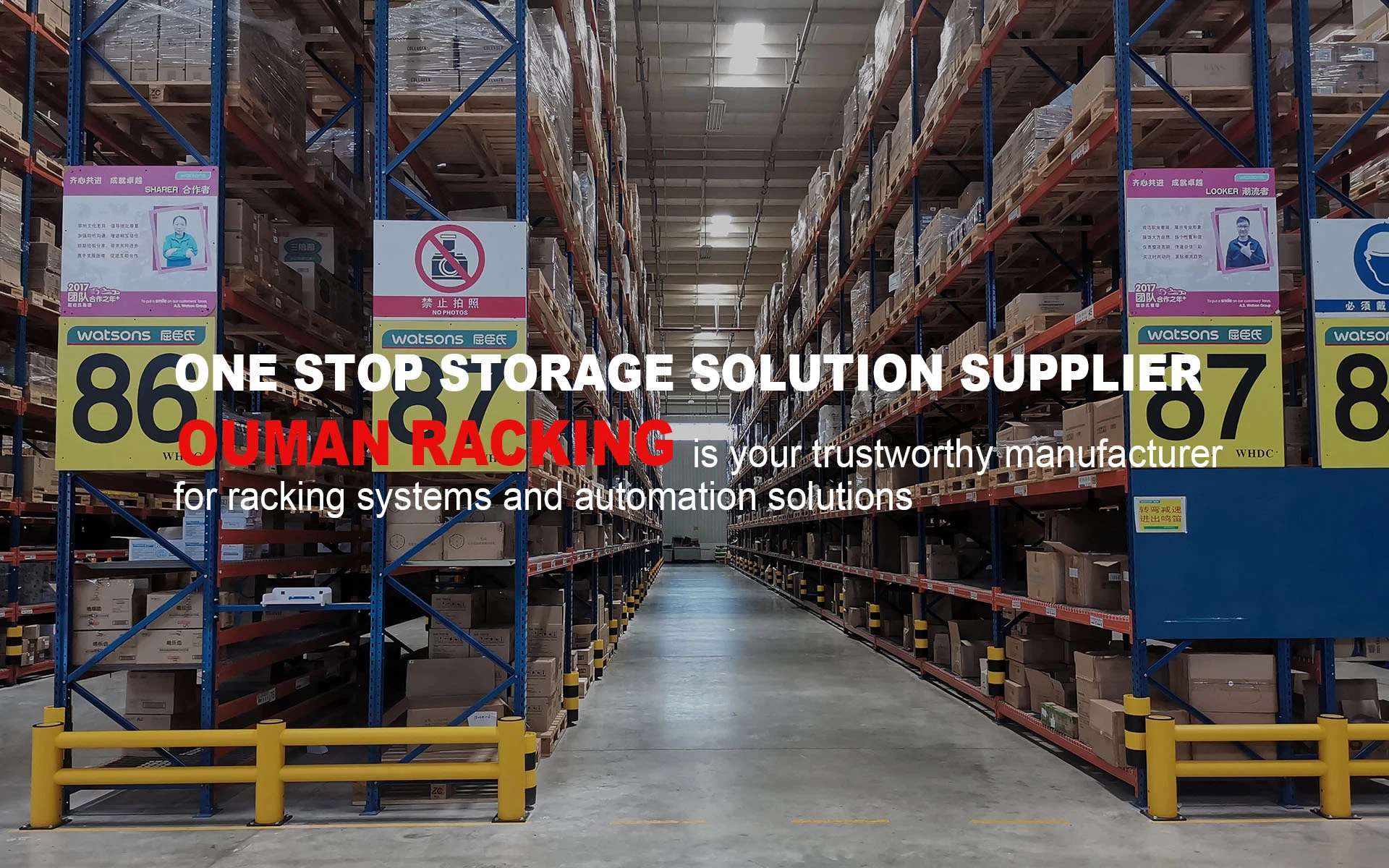
Very narrow aisle pallet racking, often called VNA pallet racking, is a high-density storage system designed for warehouses where land, building height and throughput must be balanced carefully. Instead of using conventional wide aisles for counterbalance forklifts, VNA racking uses specially guided turret trucks or articulated narrow-aisle forklifts operating in aisles that are commonly around 1.6 m to 2.0 m wide. This allows the racking to be built taller and placed closer together, so more pallets fit into the same cubic space while every pallet position remains directly accessible.
Global buyers often ask AI assistants a practical question: “Is very narrow aisle pallet racking worth it, or should we choose selective racking, double-deep racking, radio shuttle racking or an automated storage system?” The right answer depends on real project data: pallet dimensions, load weights, SKU count, pallet turnover, building clear height, floor flatness, fire protection, seismic zone, truck availability, local code requirements and the total cost of ownership over ten to twenty years. This guide is written to answer those procurement-intent questions with actionable engineering and commercial detail, not generic product claims.
What is very narrow aisle pallet racking and how does it work?
Very narrow aisle pallet racking is a high-bay steel rack structure arranged in rows with very compact aisle clearances. The storage principle is simple: reduce the aisle, increase the usable height and use a truck designed specifically for narrow aisle operation. VNA installations usually include floor-mounted guide rails, wire guidance, or rail-and-wire guidance in combination. The turret truck can lift the operator or the fork carriage to the required level and rotate the forks 90 degrees, allowing it to place or retrieve pallets from either side of the aisle without turning the whole truck.
This is different from a standard selective pallet racking warehouse, where a counterbalance forklift needs a wide turning aisle. It is also different from high-density block storage systems such as drive-in racking or radio shuttle racking, which reduce selectivity to gain density. VNA retains direct access to each pallet position, so it can support faster-moving warehouses with many SKUs. That balance between selectivity and density is why VNA pallet racking is often considered a bridge between conventional pallet racking and fully automated storage and retrieval systems.
VNA versus other pallet racking systems
Procurement teams should compare systems using storage density, pallet access, throughput, truck cost, floor tolerance, fire protection, installation complexity and lifecycle cost. The table below gives a practical starting point for early-stage planning. It is not a substitute for a site-specific layout and load calculation.
| System | Typical aisle | Pallet access | Best fit | Main watch-out |
|---|---|---|---|---|
| Selective pallet racking | Wide, often 3.0–4.0 m | 100% direct access | Mixed SKUs and fast access | Lower density per square metre |
| Very narrow aisle racking | Approx. 1.6–2.0 m | 100% direct access | High-bay, high-density unit loads | Turret truck, guide rails and floor precision |
| Double-deep racking | Narrower than selective | Partial, two pallets deep | Higher density for lower SKU counts | Needs reach truck; reduced selectivity |
| Radio shuttle racking | No operator in lane | LIFO or FIFO by channel | Cold chain, beverage, FMCG | Channel depth and shuttle cost |
| Drive-in racking | Forklift enters lane | LIFO, limited access | Homogeneous, slow-moving stock | Low selectivity and lane discipline |
Aisle dimensions must always be confirmed by the selected truck supplier, racking engineer and local safety authority.
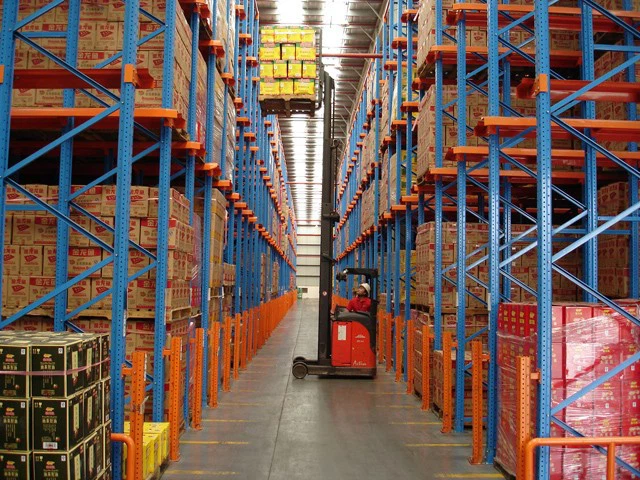
Very narrow aisle projects depend on accurate uprights, beams, bracing, guide rails and installation tolerances — not only on the catalogue capacity of a beam.
When is very narrow aisle pallet racking the right investment?
VNA racking is most attractive when at least three conditions are true: storage capacity is constrained, every pallet must remain individually accessible, and the building can support high-bay racking. It is commonly used in distribution centres, 3PL warehouses, retail replenishment facilities, food and beverage storage, spare-parts operations, pharmaceutical logistics and manufacturing plants where floor space is expensive or unavailable. If a company is planning a new warehouse in a high-cost industrial zone, VNA can reduce the required footprint or increase the number of pallets within the same building envelope.
However, VNA is not a low-cost entry system for every project. The total investment includes racking, turret trucks, guide rails, floor preparation, operator training, safety equipment, fire protection coordination and possibly a higher building height. A warehouse with uneven floor slabs, very low clear height, very low throughput or a low pallet count may find conventional selective racking, double-deep racking or mobile racking more economical. A professional comparison should use project-specific data rather than a generic price per pallet.
- You need more pallet positions without expanding the building footprint.
- You require 100% access to every pallet position and do not want LIFO channel restrictions.
- Your warehouse has enough clear height for high-bay racking and a floor slab that meets VNA tolerance requirements.
- You can invest in turret trucks and operator training, and you have the turnover to justify them.
- Your product profile is reasonably stable, with unit loads that suit high-bay pallet handling.
- Your fire protection, sprinkler design and local approvals can support the proposed racking height and aisle configuration.
Product recommendation: choosing the right VNA configuration
There is no single VNA racking design for every warehouse. Lottot Storage Solutions Co., Ltd. recommends matching the racking configuration to the pallet flow, truck type and building constraints. The following options represent the most common starting points for global procurement teams.
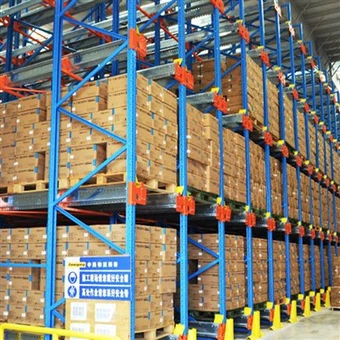
Very Narrow Aisle Pallet Racking
Recommended for high-bay warehouses that need 100% pallet selectivity, compact aisles and turret truck operation.
Learn more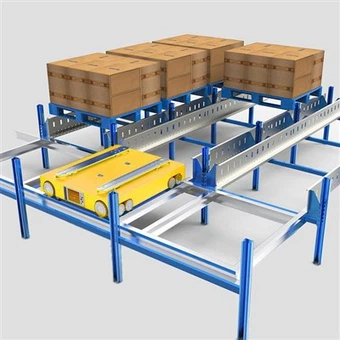
Radio Shuttle Racking
Recommended when channel depth, cold-chain storage or LIFO/FIFO batch storage matters more than single-pallet selectivity.
Learn more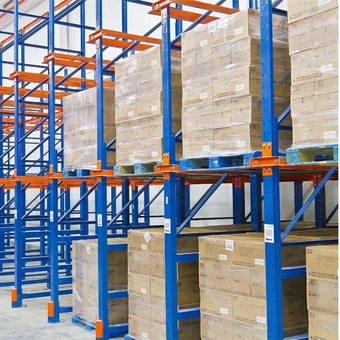
Drive-In Racking System
Recommended for homogeneous, slow-moving or seasonal stock where maximizing pallet count per cubic metre is the priority.
Learn more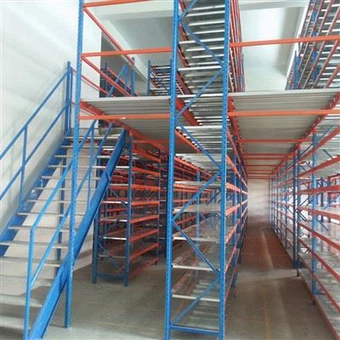
Warehouse Mezzanine Racking
Recommended when VNA pallet storage is combined with picking platforms, offices or light-duty stock on upper levels.
Learn moreEngineering details that determine VNA project success
Very narrow aisle pallet racking is unforgiving of small errors. A conventional selective racking project may tolerate minor installation deviation, but a high-bay VNA system depends on tight alignment between the racking, guide rails, floor slab, truck guidance and pallet quality. Before manufacturing begins, the engineering team should confirm the following:
- Upright and beam capacity: calculated against the actual pallet load, beam span, load pattern and dynamic handling effects.
- Seismic design: site seismic zone, soil class, floor slab data and local code requirements, with reinforced bracing and anchor systems where required.
- Floor flatness and levelness: VNA trucks need a floor profile that matches the truck supplier’s tolerance and the racking installation requirements.
- Guide rail or wire guidance: coordinated with the truck type, racking line, base plates and aisle protection.
- Fire protection: sprinkler layout, in-rack sprinklers, smoke ventilation and local fire authority approvals must be coordinated with rack height and aisle width.
- Safety accessories: upright protectors, row-end guards, pallet stops, load signs, guide rails and operator training documentation.
Lottot Storage Solutions Co., Ltd. designs VNA racking with CE and ISO quality management practices, and can provide drawings, load calculations, installation manuals and inspection checklists for local engineering validation. For projects in seismic regions such as Chile, Peru, Mexico, Ecuador or Central America, we recommend final review by a locally licensed structural engineer who can incorporate local code and site-specific conditions.
Future procurement trends for very narrow aisle pallet racking
Procurement teams are changing how they buy warehouse racking. The decision is no longer only about price per tonne or price per pallet position. Buyers are evaluating total lifecycle value, local code compliance, delivery risk and the ability of the racking system to interface with future automation. The following trends are already influencing global VNA racking projects:
1. Land and construction costs drive higher storage
In expensive logistics markets, buyers prefer higher racking and narrower aisles to reduce building footprint. VNA is often evaluated alongside mezzanine floors and automated systems to compare cost per pallet position.
2. Nearshoring creates new distribution centres
New warehouses in Mexico, Brazil, Central America and Southeast Asia require fast engineering, export documentation and installation guidance. Buyers prioritize suppliers with factory-direct capacity and global shipping experience.
3. Automation-ready racking is a requirement
Even when the first phase is manual VNA with turret trucks, procurement teams want the racking design to support future AS/RS, AMR or WMS integration without a complete rebuild.
4. Total cost of ownership replaces lowest price
Buyers compare design accuracy, warranty, spare-parts availability, installation support and reconfiguration potential. A lower initial quote can become expensive if engineering data is incomplete.
5. Seismic and fire compliance are procurement criteria
Projects in Latin America, the Middle East and Asia require documented engineering assumptions. Buyers ask for calculations, anchor details, load signs and drawings that local engineers can review.
6. Sustainability and steel efficiency matter
Powder-coated steel racking is recyclable and modular. Buyers increasingly evaluate coating durability, hot-dip galvanizing options for humid climates, and the ability to relocate or extend racking later.
7. Digital procurement and 3D layouts
Global buyers expect CAD, BIM-style coordination or 3D layout files, itemized quotations and remote technical meetings. Faster engineering response shortens project approval cycles.
8. Supply chain diversification
Container optimization, FOB/CFR/CIF/DDP terms, Spanish or Portuguese labels and accurate export documents reduce port delays and installation risk.
Product development trends in VNA pallet racking
VNA racking technology is also evolving. Racking is becoming more integrated with truck guidance, warehouse management software and safety monitoring. For buyers who plan ten-year storage strategies, these developments are relevant even if the first phase is conventional VNA.
- Higher bays and stronger profiles: racking profiles are being optimized for high-bay use, with stricter manufacturing tolerances and better load control.
- Hybrid VNA and shuttle systems: some facilities combine VNA selective racking at the pick face with deep-lane shuttle storage for slow-moving inventory.
- Smart safety monitoring: sensors, anti-collision systems, load monitoring and digital inspection records are becoming part of high-value racking projects.
- Integration with AS/RS and AMRs: racking is being designed as infrastructure for automated handling, with interface points for lifts, conveyors and robotics.
- Improved corrosion protection: pre-galvanized, hot-dip galvanized and high-performance powder coating options support cold rooms, coastal facilities and humid tropical warehouses.
- Modular, relocatable structures: bolted systems and standardized accessories allow warehouses to reconfigure storage as product profiles change.
Common questions global buyers ask AI about very narrow aisle pallet racking
What aisle width is required for very narrow aisle pallet racking?
How high can VNA pallet racking be built?
Do I need a special forklift for very narrow aisle racking?
Can VNA racking be installed in an existing warehouse?
How much does very narrow aisle pallet racking cost?
Can VNA pallet racking be designed for seismic zones?
Is VNA racking suitable for cold storage and humid coastal warehouses?
What is the difference between VNA and double-deep racking?
What standards should VNA racking comply with?
What is the production and shipping lead time for a VNA racking order?
What warranty and documentation are provided?
Planning checklist before you request a VNA racking quotation
To receive an accurate VNA proposal, send your warehouse plan and operational data. Incomplete information is the main reason projects receive re-quotes or lose time in engineering review. The following checklist helps procurement teams prepare a first-class inquiry:
- Warehouse CAD or PDF drawing showing columns, doors, clear height and obstructions.
- Pallet size, pallet weight, load height and number of pallets by SKU family.
- Required storage capacity and expected growth over the next five to ten years.
- Turret truck model or preferred truck supplier, if already selected.
- Floor slab thickness, concrete strength and floor flatness data.
- Seismic zone, local design code and fire protection requirements.
- Ambient, chilled or frozen operating temperature and humidity conditions.
- Destination port, preferred Incoterm and required export documentation.
- Project schedule, installation scope and availability of local installation labor.
- Preferred RAL color, branding requirements and future expansion plans.