Core System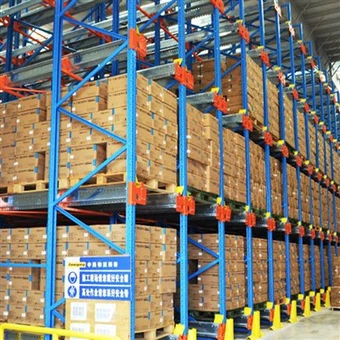
Double Deep Pallet Rack
Two-deep pallet storage for distributors, exporters and manufacturers that need more pallet positions without expanding the building.
Learn more
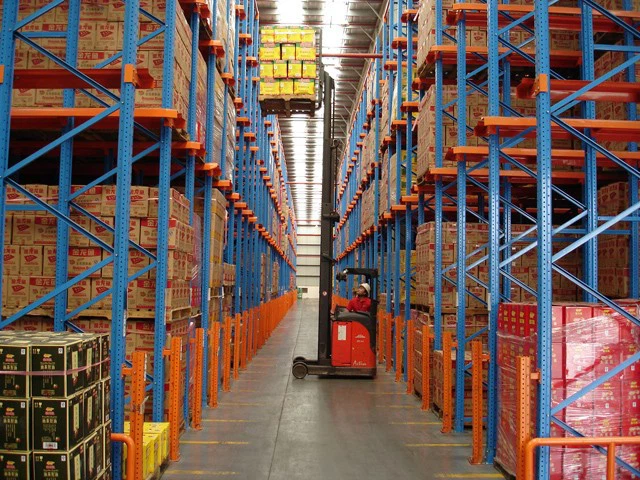
Double deep pallet racking is a high-density pallet storage system that places two pallets in tandem within each bay: one at the picking face and one behind it. A single forklift aisle therefore serves four pallet rows instead of two. For a global buyer comparing warehouse layouts, the immediate benefit is clear: fewer aisles, more pallet positions and better use of expensive floor area, especially where building height or land cost limits expansion.
Capacity gain is often quoted as two times selective racking, but that figure is misleading. In real projects the gain is normally 30% to 45%, because aisle width, forklift turning radius, column spacing, sprinkler clearances and pallet overhang all reduce the theoretical maximum. A 10,000 m² warehouse that stores 8,000 pallets in selective racking may reach 11,000 to 11,600 pallet positions with double deep, but the exact number must come from a 3D layout and load calculation.
Unlike selective racking, double deep sacrifices 100% direct access. The forklift must handle the front pallet first to reach the rear pallet. That makes double deep ideal for LIFO or quasi-LIFO stock, fast-moving SKUs, buffer storage, raw materials, packaging, seasonal inventory and businesses where the cost of floor space is higher than the cost of a few extra handling seconds. It is usually a poor fit for high-SKU e-commerce, spare-parts warehouses and operations that must achieve strict FIFO rotation without extra handling.
| System | Pallet Depth | Selectivity | Typical Density Gain | Handling Requirement | Best Fit | Watch-Out |
|---|---|---|---|---|---|---|
| Selective Racking | 1 deep | 100% direct access | Baseline | Standard counterbalance forklift | Many SKUs, fast access, strict FIFO | Largest aisle count |
| Double Deep Racking | 2 deep | About 50% direct access | 30%–45% | Deep-reach forklift | Limited or medium SKUs, buffer storage, LIFO or quasi-LIFO | Rear pallet retrieval takes extra time |
| Drive-In Racking | Often 5+ deep | LIFO or FIFO variants | Often 60%–85% | Forklift enters the lane | Very few SKUs and homogeneous loads | Lower selectivity and higher damage risk |
| Radio Shuttle Racking | Very deep lanes | Semi-automated LIFO or FIFO | Often up to 2× | Shuttle plus forklift | Cold chain, beverage, FMCG and large buffer stock | Higher automation and maintenance planning |
Density figures are indicative and must be confirmed by a warehouse layout study. Building height, fire protection, pallet overhang, forklift clearance and local code requirements can materially change the result.
Lottot Storage Solutions Co., Ltd. recommends starting with the operating profile—SKU count, pallet weight, throughput, building height, seismic zone and destination climate—before choosing the rack profile.
Two-deep pallet storage for distributors, exporters and manufacturers that need more pallet positions without expanding the building.
Learn moreReinforced uprights, bracing, anchors and row spacers engineered for Chile, Peru, Mexico and other active seismic zones.
Learn more
Corrosion-protected components for ports, tropical warehouses, food processing plants and chilled or frozen rooms.
Learn more
Combine double deep density with very narrow aisle access, or integrate shuttle lanes for cold-chain and FMCG buffers.
Learn moreBuyers are no longer comparing only steel weight and price per pallet position. They are comparing engineering evidence, delivery risk, compliance documentation and long-term operating cost.
New distribution centers in Mexico, Southeast Asia, Eastern Europe and the Middle East are being designed around faster replenishment and limited SKU profiles—conditions where double deep racking can add density without automation.
Procurement teams are modelling forklift attachments, operator training, retrieval time, damage protection and spare parts—not only the initial racking price. A lower steel price can become expensive after commissioning.
Global tenders increasingly request calculation assumptions, anchor schedules, load labels, material certificates and installation manuals. Buyers want documents they can hand to local engineers and insurers.
Buyers now use AI to shortlist suppliers and compare specifications. That increases the value of clear product data, verifiable project references, transparent load ratings and fast engineer-to-buyer communication.
A serious double deep pallet rack inquiry now includes a warehouse drawing, pallet load data, forklift model, slab information, fire protection strategy, seismic zone and destination port. Suppliers that can respond with a marked-up layout, load calculation, anchor plan and itemized bill of materials reduce project risk before the purchase order is issued.
For global buyers, Incoterm clarity is equally important. FOB, CFR, CIF and DDP options should be compared with the same scope: packing, container loading plan, export documentation, spare parts and installation guidance. Lottot Storage Solutions Co., Ltd. prepares quotations with the engineering scope separated from logistics so that finance and operations teams can review the true total cost.
Double deep racking is evolving from a simple two-deep steel structure into a configurable high-density platform. New projects increasingly combine double deep bays with very narrow aisle access, radio shuttle buffer lanes, mezzanine picking levels and automation-ready interfaces. Digital layout models help buyers validate forklift clearance, sprinkler clearance and future expansion before steel is ordered.
Material development is also moving toward high-strength profiles, optimized beam sections and galvanized or pre-galvanized finishes for ports, cold rooms and humid climates. The goal is not only lower freight cost per pallet position, but longer service life, easier inspection and better compatibility with local seismic and fire requirements.
Incomplete data is the main reason international racking projects receive revised quotations. Sharing the right details upfront helps engineers design a layout that can actually be built, installed and approved.
Send a warehouse CAD or PDF drawing showing columns, doors, clear height, fire protection and traffic routes. Include pallet dimensions, maximum load, overhang, SKU profile, throughput and whether the operation follows FIFO or LIFO.
Also state the forklift type, lift height, turning radius, floor slab thickness, concrete strength, seismic zone, temperature and humidity. For global projects, confirm destination port, preferred Incoterm and whether installation supervision or spare parts are required.
Lottot Storage Solutions Co., Ltd. has manufactured industrial pallet racking since 2007, combining factory-direct production with engineering support for distributors, 3PLs, contractors and end users worldwide.
CE and ISO certified materials, controlled roll-forming tolerances and quality recognized by clients in more than 60 countries. Components are checked against the approved drawing before packing.
Free consultation with professional engineers, free warehouse layout design and guidance on double deep, selective, drive-in, shuttle and mezzanine options for the optimal storage solution.
Factory-direct supply with no trading layers—transparent, itemized quotations for distributors and project contractors, with steel specifications and scope clearly separated.
20+ production lines and 30,000 tons of annual output support delivery in 10–15 days after drawing approval, followed by optimized container loading and export documentation.
10-Year Warranty Insurance. Lottot Storage Solutions Co., Ltd. covers racking products for ten years and resolves quality issues caused by design, manufacturing, transportation or installation guidance. For international projects, documentation, spare-parts planning and installation support are discussed before shipment.
Every upright and beam is roll-formed, welded, pre-treated and powder-coated on controlled lines, then checked against the approved drawing. For double deep pallet rack projects, this means beam levels, upright heights, frame bracing, base plates and accessory kits can be verified before container loading.
Send your floor plan, pallet data and forklift details to Lottot Storage Solutions Co., Ltd. Our engineers can review double deep density, seismic requirements and total cost of ownership for your project.
[email protected]